Most Summerset houses are younger than the city's own charter — and none of that matters to the rock underneath. Test the house; if the number's high, we'll fix it and prove it.
Call (605) 600-8804Tell us your test result, your foundation type, and whether there's already a passive pipe in the house — we'll quote it firm. Call (605) 600-8804 or send the form.
Summerset only incorporated in 2005, and the subdivisions filling in along I-90 between Black Hawk and Piedmont make it feel newer still. But a city charter is paperwork; the ground is Precambrian. The Black Hills' granite-and-metamorphic core carries naturally uranium-bearing rock, and as that uranium decays to radium and then to radon gas, the gas rises into whatever's built on top — whether the slab cured forty years ago or last fall. The EPA and USGS map a high-radon-potential ridge around the Hills, and Summerset's corridor is on it.
So the question for a Summerset homeowner isn't "is my house too new for radon?" — it's "what does my house actually read?" Roughly half of tested South Dakota homes come back above the EPA action level of 4.0 pCi/L, and the only way to find out which half yours is in is a 48-hour test. More on the geology here →
Radon doesn't check the certificate of occupancy. It enters through the same paths in a new slab as an old one — shrinkage cracks, control joints, utility penetrations, sump pits — and a newly built home over active soil gas can test just as high as its older neighbors. Two houses on the same Summerset street, framed the same summer by the same crew, can still return very different numbers.
A few things about testing a newer Summerset home:
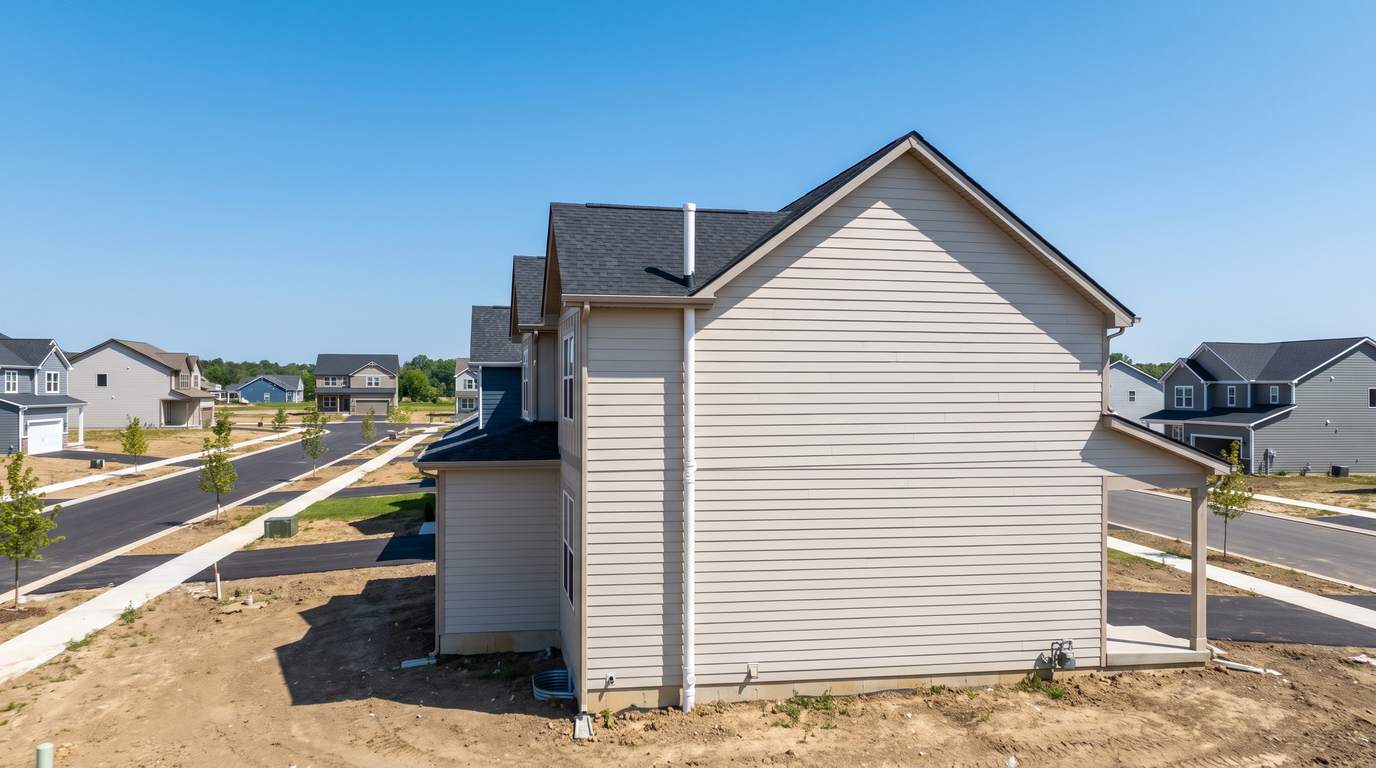
Here's the good news hiding in all that new construction: many newer homes come with a passive radon rough-in already in the walls — a PVC pipe from under the slab through the roof, no fan attached. If your test comes back at 4.0 pCi/L or higher, that pipe means most of the system is already built.
Converting it to a working active sub-slab depressurization system is a short job: we add a correctly rated inline fan, seal the slab details the builder's rough-in didn't, mount a U-tube manometer so you can confirm suction at a glance, and finish with a post-mitigation verification test. The fan then runs quietly around the clock for about $3 a month. Because the piping and roof penetration already exist, conversions typically cost less than the standard from-scratch install, which runs about $1,200–$2,500 in this area — the cost page has the full picture. No pipe in your house? No problem — the from-scratch version installs in a single three-to-five-hour visit, and if you're mid-purchase, our real estate page explains how it fits a closing timeline.
One call gets you an honest read on whether you need anything at all — and a firm written price if you do.
(605) 600-8804Yes. Radon comes from uranium decaying in the rock and soil beneath the foundation, and it enters new slabs the same way it enters old ones — through cracks, joints, and utility penetrations. Statewide, roughly half of tested South Dakota homes come back above the 4.0 pCi/L action level, and construction date is no exemption. A 48-hour test settles it either way.
That's most likely a passive radon rough-in — a pipe the builder ran from under the slab up through the roof, with no fan on it. It vents some soil gas by natural airflow, but it isn't a finished mitigation system, and homes with passive pipes can still test high. Test first; if the number is elevated, the pipe becomes the backbone of a proper active system.
Usually, yes — the expensive parts, the piping and the roof penetration, already exist. Converting means adding a correctly rated inline fan, sealing what the rough-in missed, mounting a manometer, and running a verification test. For comparison, a full standard system in the Rapid City area runs about $1,200 to $2,500 installed — see the cost breakdown. Either way you get a firm written price first.
Run a short-term test for at least 48 hours under closed-house conditions — windows and doors shut for 12 hours before and during. The South Dakota DANR gives away 500 free short-term kits to residents each year, first come, first served, which is a fine first step. Use a professional test when a real-estate deadline needs a defensible number or to verify a mitigation system.