High radon in a home over a crawl space? That's one of the most fixable results there is. We seal the dirt, put the soil under suction, and hand you a drier crawl space and a verified number.
Call (605) 600-8804Tell us your test result and roughly how big the crawl space is, and we'll price the fix — sealed, depressurized, and verified. Call (605) 600-8804 or send the form.
A crawl space is one of the most radon-prone foundation types because nothing but a few feet of air separates your floor from open soil. Radon starts as uranium in rock, decays to radium and then to radon gas, and rises freely out of exposed dirt. Where a basement slab at least slows the gas down, a bare crawl space floor releases it straight into the cavity under your home — and from there it rides plumbing chases, wiring holes, duct runs, and floor gaps into the rooms above, pulled along by the natural stack effect of warm air rising.
Around Rapid City, the ground gives that process plenty to work with. The city sits where the plains meet the granite and metamorphic core of the Black Hills, rock that carries naturally uranium-rich veins. Pennington County is mapped EPA Zone 2, yet state test data has shown more than half of local radon tests coming back above the 4.0 pCi/L action level, and the lab-reported average for area homes runs near 11 pCi/L — far past what the map predicts. A home with an open dirt crawl space over that geology is close to a worst-case setup for radon entry. The geology story is worth five minutes: see why Black Hills homes test high.
Our long South Dakota winters sharpen the problem. Months of closed doors and windows trap what rises, and a running furnace pulls make-up air from the lowest, leakiest part of the house — the crawl space — dragging soil gas up with it. Shutting the vents won't solve it; the gas isn't coming through the vents. The reliable fix is to seal the floor and put the soil itself under suction.
The standard crawl space fix is sub-membrane depressurization — the crawl space version of the sub-slab systems we install under basements. Since there's no concrete to draw through, we build the seal ourselves, then pull the radon out from underneath it.
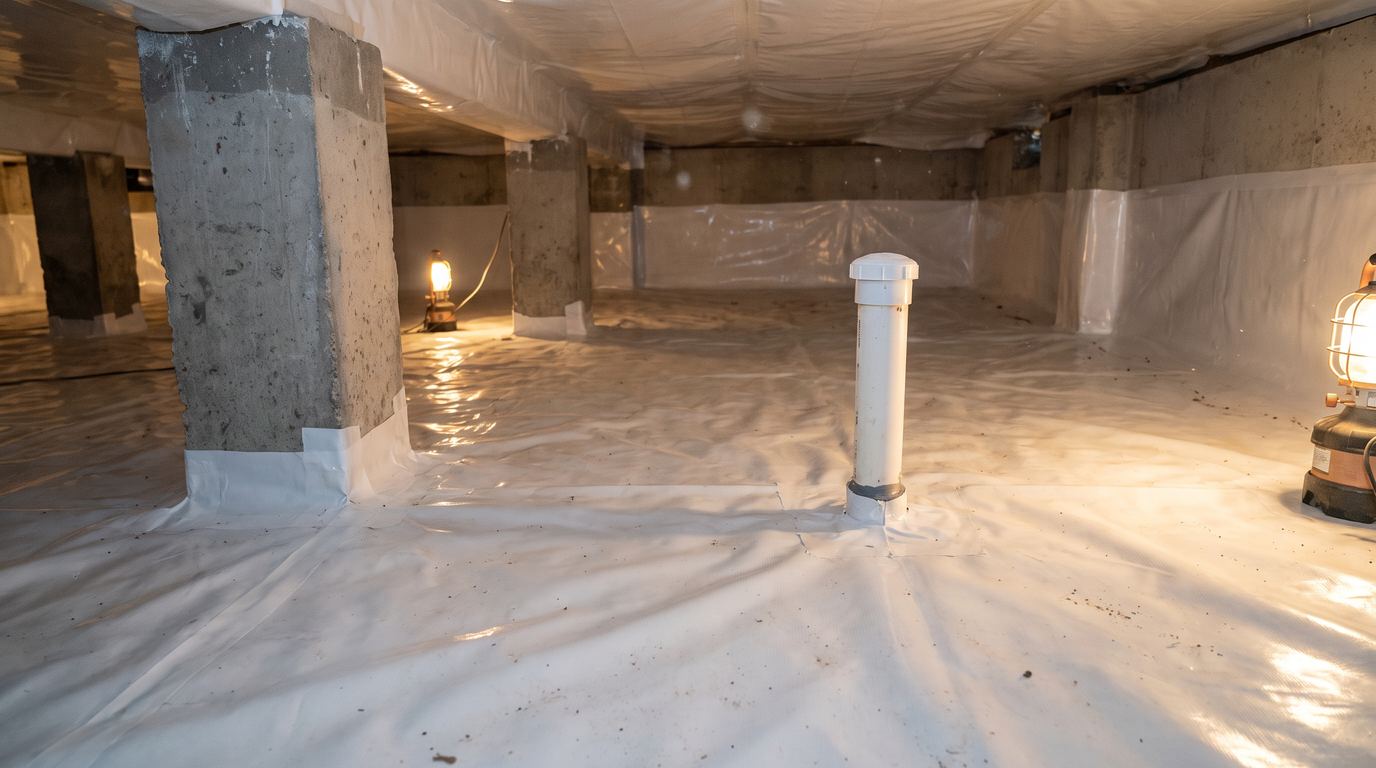
Here's how the install goes:
Once running, the fan keeps the ground beneath the membrane at slightly lower pressure than the crawl space above it, so radon follows the pipe out instead of seeping up through your floors. Same dependable physics as a slab system — the membrane simply plays the role the concrete would.
The sealed barrier at the heart of a crawl space radon system is the same material used for crawl space encapsulation, which is why the two upgrades pair so well. Encapsulation fully lines the crawl space — floor and walls — to lock out ground moisture and soil air. By itself it's a moisture project, not a radon fix; without active suction under the liner, the gas still finds a path. Tie that liner into a depressurization fan, though, and one crew visit delivers both outcomes.
In our climate, the moisture half of the bundle earns its keep. South Dakota's freeze-thaw swings and spring snowmelt push ground moisture up under homes for much of the year, and prairie wind drives cold, damp air through open crawl space vents all winter. A sealed, depressurized crawl space blocks that moisture at the dirt, which means lower humidity under the house, warmer floors that are easier to heat, and protection for joists, insulation, and ductwork — along with relief from the musty smell that so often drifts up to the main floor. We're straightforward about the order of operations: the system is designed and verified to lower radon first, and the drier crawl space comes along with doing that job correctly.
Every foundation type gets the same goal — capture radon in the soil before it reaches your air — but the method follows the floor. A basement or slab home already has concrete acting as the seal, so sub-slab depressurization simply cores through it and draws from the gravel beneath. A crawl space starts with no seal at all, which changes the job in a few ways:
Then there's the layout we see constantly around here: the combination foundation. A big share of Rapid City's ranch homes were built with a partial basement plus a crawl space under an addition, a garage-side wing, or the back bedrooms. Treating only one section is how systems end up with a disappointing re-test — the untreated half keeps feeding gas to the whole house. We design these as one system: a sub-slab point in the basement, a sub-membrane point under the crawl section, usually manifolded into a single fan, and one verification test for the entire home.
Expect a crawl space system to price above a standard slab install — there's simply more material and labor in sealing an entire floor than in coring one hole through concrete. For reference, a standard single-suction sub-slab system in the Rapid City area typically runs about $1,200 to $2,500 installed; sub-membrane and crawl space work sits at the top of that range or above it. What moves the number:
You'll get a firm written price after we look at the space — never a guess over the phone that grows on install day. For the full picture of what a system costs to buy and to run, see our radon mitigation cost guide. Haven't confirmed your level yet? Start with radon testing.
If your crawl space home tested high, we'll show you exactly how we'd fix it — with a firm written price, a moisture upgrade if you want it, and a follow-up test that proves it worked.
(605) 600-8804With sub-membrane depressurization. We cover the exposed dirt with a heavy vapor barrier, seal it at the walls, seams, and support piers, and run a suction pipe beneath it to an inline fan that vents above the roofline. The fan holds the soil under the barrier at lower pressure than the space above, so radon leaves through the pipe instead of rising into your home. A follow-up test confirms the level dropped below 4.0 pCi/L.
No — they're partners, not substitutes. Encapsulation lines the crawl space in a sealed barrier to shut out ground moisture; on its own it won't reliably lower radon. Mitigation adds the suction pipe and fan that actively pull soil gas from beneath that barrier. Because both jobs share the same membrane, doing them together costs less than doing them separately — you get a drier crawl space and a lower radon number from one project.
More than a standard slab job, because we have to build the seal instead of borrowing your concrete. A standard single-suction sub-slab system in the Rapid City area typically runs about $1,200 to $2,500 installed; sub-membrane work prices at the top of that range or above, depending on square footage, access, and whether you add full encapsulation. We put a firm number in writing after we see the space. See the full cost guide.
No. Radon comes up out of the soil, not in through the vents, so closing them doesn't stop it — in some homes it actually concentrates the gas. The dependable fix is a sealed barrier over the dirt with active suction beneath it. Vent strategy is part of the moisture plan, but it is never the radon fix by itself.
Usually, yes. Plenty of Rapid City ranch homes pair a partial basement with a crawl space under an addition or a back wing. We design a combination system — a sub-slab suction point for the concrete section and a sub-membrane point for the dirt section — often manifolded to a single fan. The post-mitigation test covers the whole house, so you know both halves are handled.