Just opened a high test result — or racing an inspection deadline? We design and install radon systems across Rapid City and the Black Hills, and we prove the number came down.
Call (605) 600-8804Tell us your test result and your foundation type and we'll give you a firm price — no high-pressure sales visit. Call (605) 600-8804 or send the form.
From a first test to a finished, verified system, Rapid City Radon handles the whole job for homeowners, buyers and sellers, property managers, and commercial owners across the Rapid City area. Every install is built to the national ANSI/AARST radon standards and confirmed with a follow-up test.
Active sub-slab depressurization systems that pull radon out from under your home and vent it safely above the roofline.
How it works →Professional short- and long-term testing, plus post-mitigation verification so you know your number for certain.
Radon Testing →Straight answers on what a system costs in the Rapid City area and what drives the price up or down.
See pricing →Fast testing and mitigation on closing timelines, plus what South Dakota's disclosure form requires of sellers.
Buying or selling →Sub-membrane systems and encapsulation that seal and depressurize dirt and crawl space foundations.
Crawl spaces →Replacing failed radon fans and fixing underperforming systems — any brand, including builder passive systems.
Repairs →Radon mitigation is the process of installing a vent system that captures radon gas beneath your foundation and releases it above the roof, before it can build up in the air you breathe. For the vast majority of Rapid City homes, that means an active sub-slab depressurization (ASD) system: a sealed PVC pipe drawn through the slab or crawl space, an inline fan that runs continuously, and a discharge point above the eave.
The physics are simple and reliable. Radon comes from uranium in soil and rock decaying into radium and then into radon gas, which seeps up through cracks, sump pits, and the pores in concrete. A mitigation fan puts the soil under your slab at slightly lower pressure than the house, so the gas follows the pipe out instead of drifting up into your living space. Done correctly, it is one of the most dependable fixes in the building trades — and it keeps working for as long as the fan runs, at a running cost of about $3 a month.
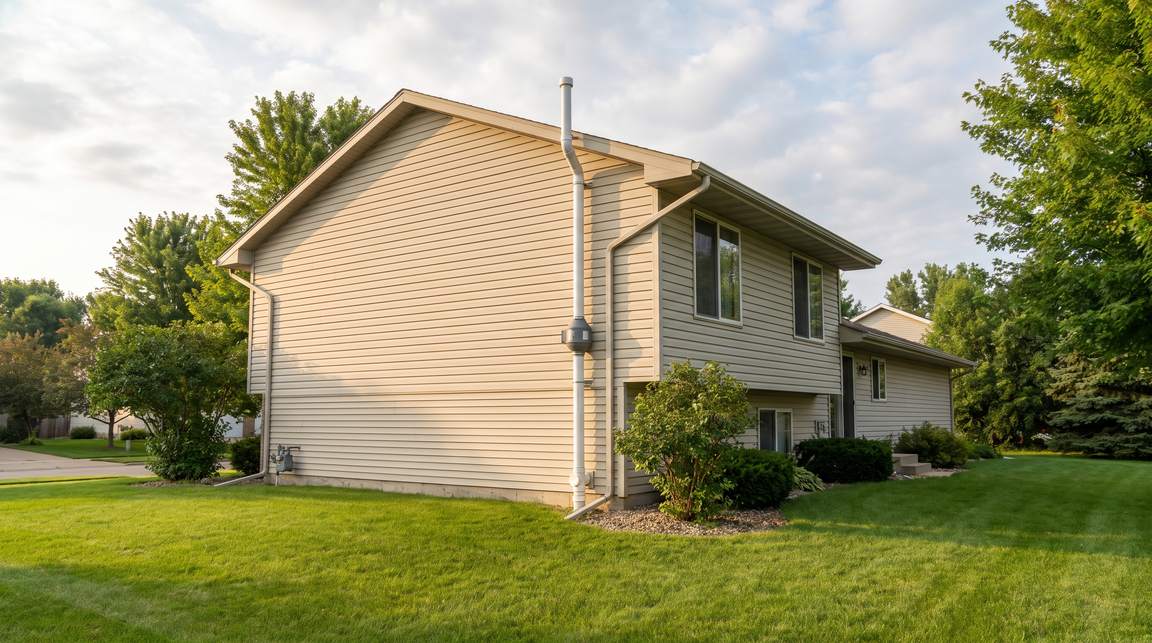
A standard install with Rapid City Radon includes:
On the EPA's radon map, Pennington County sits in Zone 2 — the middle tier, with a predicted average of 2–4 pCi/L. Plenty of Rapid City homeowners have looked at that map and decided testing could wait. The actual test results tell a different story: state test data has shown more than half of Pennington County radon tests coming back above the 4.0 pCi/L action level, and the lab-reported average for local homes runs near 11 pCi/L — several times the map's prediction.
Geology explains the gap. Rapid City sits where the plains meet the granite and metamorphic core of the Black Hills — rock that carries naturally uranium-rich veins. As that uranium decays, radon gas works upward into basements and crawl spaces, and our long, closed-up winters concentrate it indoors. State data has flagged Rapid Valley, Robbinsdale, and the neighborhoods south of the hospital as recurring hot spots, and individual homes in the Hills have tested above 100 pCi/L. Read why the Black Hills test so high →
The takeaway for a homeowner is straightforward: zone maps and county averages can't tell you what's happening in your house. Two identical homes on the same street can test wildly differently. The only way to know is to test — and if the number is high, to fix it.
Whether you just opened a high test result or you're getting ahead of a sale, we'll walk you through exactly what it means and what it costs — today.
(605) 600-8804A standard single-suction sub-slab system in the Rapid City area typically runs about $1,200 to $2,500 installed — the South Dakota DANR puts the statewide average at roughly $1,200. Crawl-space, multi-suction, and large finished-basement homes run higher. We give a firm, written price after we see your foundation. See the full cost breakdown.
Yes. A properly designed active sub-slab system routinely brings double-digit readings down below the 4.0 pCi/L action level. We prove it with a post-mitigation verification test — if the number isn't down, we're not finished.
A typical residential system goes in during a single visit, usually three to five hours. You don't need to leave your home while we work.
Yes — more than the EPA map suggests. Pennington County is mapped Zone 2, but state test data has shown more than half of local tests above 4.0 pCi/L, with hot spots in Rapid Valley, Robbinsdale, and south of the hospital. Statewide, roughly half of tested South Dakota homes come back elevated — among the highest rates in the nation. Here's why.
The fan runs 24/7, but a correctly sized, properly mounted fan is quiet — most homeowners stop noticing it within a day, and it costs about $3 a month to run. A system that hums or rattles usually has the wrong fan or a mounting problem, both of which we repair.
The South Dakota DANR gives away 500 free short-term test kits to residents each year, first come, first served — and we'd honestly rather you use one than not test at all. Hire a professional test when a real-estate deal needs a defensible number on a deadline, or to verify a mitigation system actually worked.