Radon in the Black Hills: Why Rapid City Homes Test High

The EPA's map calls Pennington County a middle-tier radon zone. The test results coming out of Rapid City basements say otherwise. Here's the geology, the numbers, and what to do about them.

Call (605) 600-8804
Free quotes · Honest testing advice · Every install verified by test
ANSI/AARST-Standard Installs
Every Install Verified by Test
Local to the Black Hills

Know What Your House Is Breathing

Maps predict; tests measure. Tell us your neighborhood and foundation type and we'll help you get a real number for your own home — call (605) 600-8804 or send the form.

  • Honest advice — including when a free state test kit is the right move
  • Professional testing when a deadline needs a defensible number
  • Mitigation built to ANSI/AARST standards and verified after install

What Radon Is — and How It Gets Into a House

Radon is a radioactive gas produced underground as natural uranium decays — uranium breaks down into radium, and radium breaks down into radon. You can't see it, smell it, or taste it, and the only way to know how much of it is inside a building is to measure it.

Because radon is a gas, it moves. It migrates up through soil pores and rock fractures, and where a house sits over that ground, it finds the openings every foundation has: cracks in the slab, the gap around a sump pit, plumbing and utility penetrations, exposed dirt in a crawl space. A heated home actually helps it along — warm air rising through the house pulls soil gas up through the foundation like a slow chimney. Outdoors, radon disperses instantly. Indoors, it accumulates.

Radon is measured in picocuries per liter of air (pCi/L). The EPA sets an action level of 4.0 pCi/L: at or above that, fix the home. Between 2 and 4 pCi/L, the EPA recommends you consider fixing, because the risk rises on a continuum rather than switching on at one number. The reason any of this matters is settled science: breathing radon's decay products damages lung tissue over years of exposure, and health agencies rank radon as the second-leading cause of lung cancer overall — and the leading cause among people who have never smoked. There are no short-term symptoms to warn you. That's the whole problem, and it's why testing exists.

The Geology Under the Black Hills

The Black Hills are an ancient dome of Precambrian granite and metamorphic rock, and some of that rock carries natural uranium — notably the Harney Peak granite family and the pegmatites associated with it. That's the source term for the region's radon, sitting in the ground long before anyone built a basement over it.
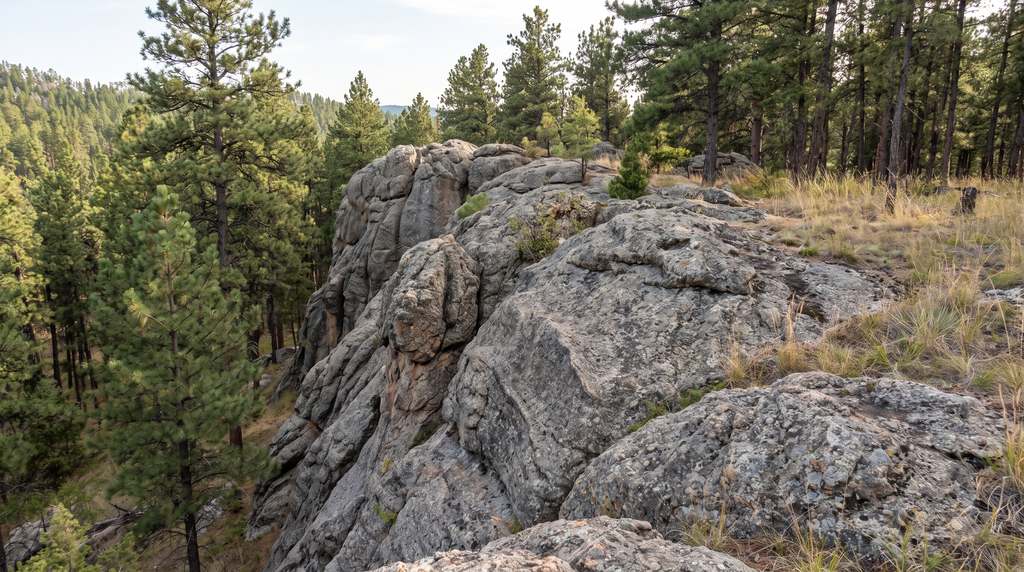
Exposed granite and pegmatite outcrop in the Black Hills — the source rock behind local radon

The chain from rock to living room is short and direct:

Federal geologists have mapped the result: EPA and USGS radon-potential work shows a ridge of high radon potential wrapping around the Black Hills, tracking that uranium-bearing core and the rock shed off of it. Rapid City sits right on the contact where the Hills meet the plains — which puts much of the city, and the fast-growing towns strung along I-90, on or beside that high-potential ground. A home's age, price, and condition don't change what's underneath it. A brand-new build in Summerset and a 1950s ranch in Robbinsdale are drawing air from the same geology.

The Zone 2 Paradox: What the Map Predicts vs. What Tests Find

Here is the strange part. On the EPA's Map of Radon Zones, Pennington County is Zone 2 — the middle tier, with a predicted average indoor level of 2–4 pCi/L. Eastern South Dakota gets the Zone 1 label. Going by the map alone, Rapid City looks like moderate-radon country. The measurements disagree.

Why the gap? Because of what a zone map is. The EPA drew its zones at the county scale to predict an average screening level, so that states could prioritize where to spend attention — a reasonable tool for policy, and the EPA itself says the map was never meant to decide whether an individual home should test. Averages flatten extremes: a county that spans both prairie and a uranium-bearing granite contact can post a modest predicted average while whole neighborhoods on the wrong side of that contact run in double digits. Radon varies at the scale of soil and bedrock — block to block, sometimes lot to lot — and no county-wide label can see that fine.

So "Zone 2" means we predict the average home here is moderate. It does not mean your home is moderate. In Pennington County, the measured data says the safer assumption runs the other way.

Winter Makes It Worse: The Closed-House Effect

Radon concentrates indoors when a house is sealed up and heated — and few places seal up longer than South Dakota. Our heating season runs deep into the year, and for months at a stretch the windows stay shut while the furnace runs. That warm rising air lowers the pressure at the foundation and pulls more soil gas inside, exactly when the house is exchanging the least air with the outdoors.

Rapid City's housing stock leans hard on basements, which compounds the effect: the basement is the closest room to the source, and around here it's often finished space — family rooms, spare bedrooms, home offices — where people spend real hours. A level that might drift past unnoticed in a slab-on-grade sunroom matters a great deal in a basement bedroom.

There's a practical upside: winter is an honest time to test. A short-term test wants closed-house conditions anyway — windows and doors shut for 12 hours before and during the test — and a South Dakota winter provides them for free.

The Statewide Picture

Rapid City's numbers aren't a local fluke — they're the sharp edge of a statewide pattern. Roughly half of tested South Dakota homes come back above the EPA action level of 4.0 pCi/L. American Lung Association analyses of state testing data have repeatedly ranked South Dakota among the very highest states in the nation — often first — for the share of elevated radon tests.

Put plainly: in most of the country, an elevated result is the exception. In South Dakota, it's close to a coin flip — and in Pennington County, the measured odds have run worse than that. That is not a reason for alarm. Radon is a long-term exposure risk with a well-understood, permanent fix. It is simply a reason to stop guessing.

What to Do With All of This

Test. It costs little or nothing, a short-term test takes a minimum of 48 hours, and it replaces every prediction on this page with a measurement of your actual house.

The geology under the Black Hills isn't going anywhere, and neither is the gap between the map and the measurements. The good news is that your house's number is knowable this week — and if it's high, fixable in an afternoon.

The Map Is a Prediction. Your Test Is a Fact.

One call gets you honest advice on testing — free kit or professional — and a firm, written price if your number needs to come down.

(605) 600-8804

Black Hills Radon FAQ

Rapid City isn't even Zone 1 — do I really need to test?

Yes. The EPA's zones predict a county's average screening level — they were drawn to help states set priorities, not to clear individual homes. Pennington County is mapped Zone 2, with a predicted average of 2–4 pCi/L, yet state test data has shown more than half of local tests coming back above 4.0 pCi/L, and the test-result average for county homes in the Air Chek lab dataset runs near 11.1 pCi/L. Known hot spots like Rapid Valley, Robbinsdale, and the neighborhoods south of the hospital sit well above the map's prediction. The map is a forecast. A test is a measurement.

My house is on granite — is that why my radon is high?

Very possibly a contributor. The Black Hills are built around a core of Precambrian granite and metamorphic rock, and the Harney Peak granite family and its related pegmatites carry natural uranium. As that uranium decays into radium and then radon gas, the gas works up through fractured rock and soil and into basements and crawl spaces. That said, two homes on the same granite can test very differently — soil, foundation, and how the house moves air all matter — so the number that counts is the one from your own test.

What radon level is considered dangerous?

The EPA's action level is 4.0 pCi/L — at or above it, the EPA recommends fixing the home. Between 2 and 4 pCi/L, the EPA says to consider fixing, because the risk doesn't switch on at a single number; it grows with the concentration and the years of exposure. Radon is the leading cause of lung cancer among people who have never smoked, which is why the sensible sequence is simple: test, and if you're at or above 4.0, mitigate.

Does South Dakota have high radon levels?

Yes — among the highest in the country. Roughly half of tested South Dakota homes come back above the EPA action level of 4.0 pCi/L, and American Lung Association analyses have repeatedly ranked South Dakota among the very highest states in the nation — often first — for the share of elevated radon tests. Long winters, basement-heavy construction, and uranium-bearing geology all play a part.

When is the best time to test a Rapid City home for radon?

Winter is ideal. South Dakota's long heating season keeps windows shut and furnaces running, which concentrates radon indoors and naturally matches the closed-house conditions a short-term test requires. But don't wait for January if you're buying, selling, or just curious — a test run any time of year under closed-house conditions (windows and doors shut 12 hours before and during) gives you a number you can act on.

Tap to Call — (605) 600-8804