State test data has flagged Rapid Valley as a recurring elevated-radon area. That's not a reason to worry — it's a reason to test. We help with both parts: an honest number, then a verified fix.
Call (605) 600-8804Already have a test result? Tell us the number and your foundation type and we'll quote it firm — no sales visit, no pressure. Call (605) 600-8804 or send the form.
Rapid Valley has earned a specific reputation in South Dakota's radon numbers: when the state health lab analyzed local testing pushes, more than half of Pennington County tests came back above the 4.0 pCi/L action level — and Rapid Valley was one of the areas the data flagged as a recurring hot spot, along with Robbinsdale and the neighborhoods south of the hospital. For an unincorporated community sitting just east of Rapid City, that's a distinction nobody asked for.
It's also worth putting in perspective. On the EPA's map, Pennington County is Zone 2 — a predicted average of just 2–4 pCi/L — yet the lab-reported average for county homes runs near 11 pCi/L. The map underestimates this area, and Rapid Valley is one of the places where the gap shows up most consistently. The community's basement-heavy homes don't help: below-grade rooms sit closest to the soil gas, and South Dakota's long closed-house winters give radon all season to accumulate.
Here's the part that matters: none of this calls for alarm. Radon is measurable in a weekend and fixable in an afternoon, and a Rapid Valley address doesn't sentence your house to a high number — it just makes testing a smarter move here than almost anywhere. Why this area tests high →
Everything in radon starts with a number, so get a real one. The South Dakota DANR distributes 500 free short-term test kits to residents each year, first come, first served — and we'd honestly rather you use one than skip testing. If a real-estate deal needs a defensible result on a deadline, or you want a mitigation system verified, use a professional test instead.
Whichever route you take, protocol decides whether the result means anything:
If your test comes back at 4.0 pCi/L or higher, the fix for most Rapid Valley homes is an active sub-slab depressurization system: a sealed pipe through the basement slab, a continuously running inline fan, and a discharge above the roofline. The fan holds the soil beneath the slab at slightly lower pressure than the house, so the gas exits through the pipe instead of your basement floor.
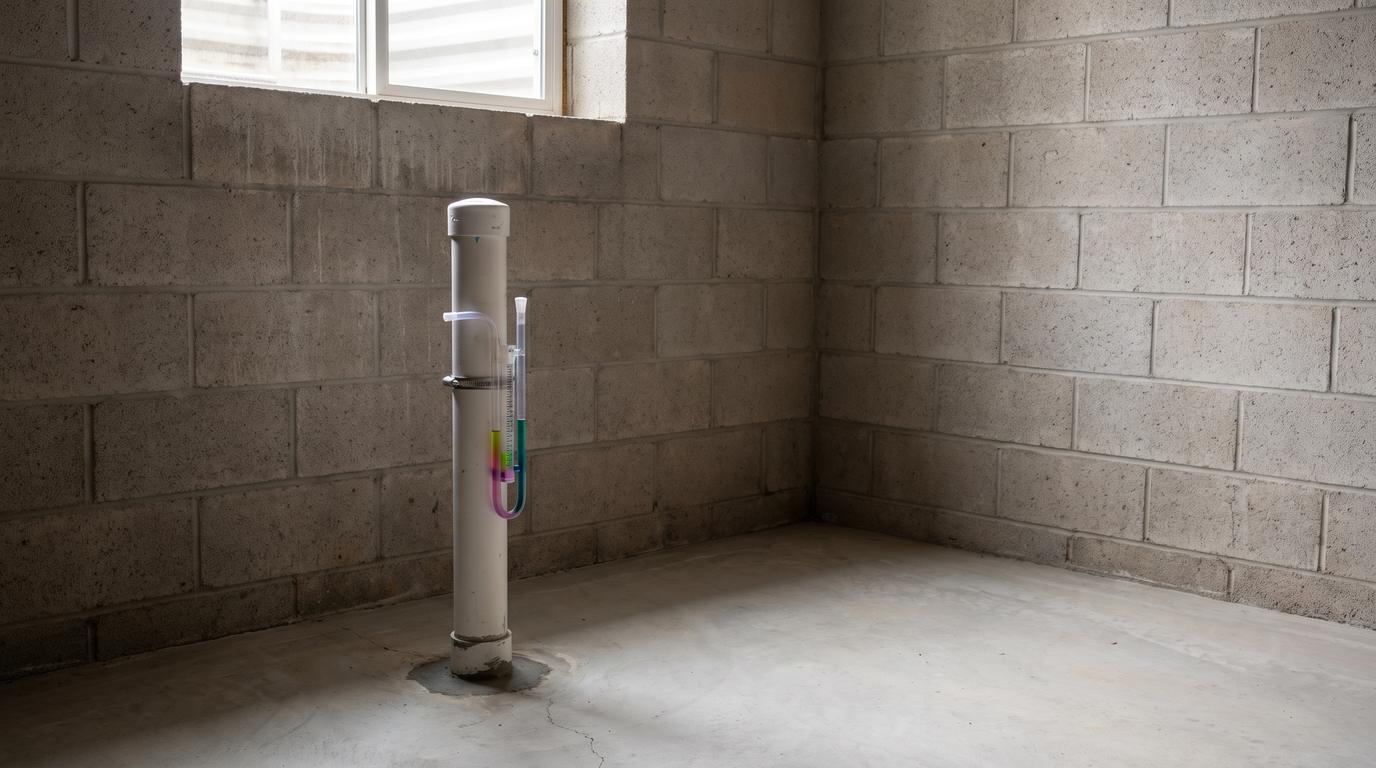
What a Rapid Valley install looks like in practice:
Systems here typically run about $1,200–$2,500 installed for a standard single-suction setup; larger or finished basements can run higher. The cost page breaks down what moves the price.
Rapid Valley shows up in the data for a reason — but your house is not a statistic. Call today and we'll help you get a real number, and a real fix if you need one.
(605) 600-8804State test data has repeatedly pointed to Rapid Valley as one of the local areas where elevated results cluster, alongside Robbinsdale and the neighborhoods south of the hospital. When the state health lab analyzed local testing pushes, more than half of Pennington County tests came back above the 4.0 pCi/L action level. A flagged area isn't a verdict on your house, though — homes vary enormously, and the only number that matters is yours.
No. Two similar houses on the same street can test wildly differently — soil pockets, foundation details, and how each house breathes all change the number. A low result next door tells you about the house next door. A 48-hour test in your own home is the only way to know where you stand.
Test — before anything else. The South Dakota DANR distributes 500 free short-term test kits to residents each year, first come, first served, and a free kit is an honest first step. Run it under closed-house conditions for at least 48 hours. If the result is 4.0 pCi/L or higher, or you need a defensible number for a real-estate deal, that's when to bring in a professional.
Fast. Rapid Valley sits just east of Rapid City, minutes from where we work every day, and a standard active sub-slab system installs in a single visit of about three to five hours. Every install ends with a post-mitigation verification test, so you're not taking our word that the number came down — you're reading it.