Radon Mitigation in Black Hawk, SD

Between the morning drive and everything waiting after it, radon is easy to put off. We make it a one-call fix for Black Hawk homes — tested, installed, and verified with a follow-up test.

Call (605) 600-8804
Free quotes · On the I-90 corridor daily · Post-mitigation test included
ANSI/AARST-Standard Installs
Every Install Verified by Test
Local to the Black Hills

Get a Free Black Hawk Radon Quote

Send your test result and foundation type — even a photo of the basement or crawl space helps — and we'll price it firm. Call (605) 600-8804 or use the form.

  • Firm, written pricing before we start
  • Installs scheduled around your workweek
  • Every install verified with a follow-up test

Radon in Black Hawk: A Bedroom Community on Restless Ground

Black Hawk is a Meade County bedroom community on I-90 between Rapid City and Summerset — and for radon purposes, the important part of that sentence is the ground it sits on, not the county line. The EPA and USGS map a high-radon-potential ridge around the Black Hills, where uranium in the region's granite and metamorphic rock decays into radium and then into radon gas. Black Hawk's stretch of the corridor is part of that ridge.

The numbers back up the map here rather than contradicting it. Roughly half of tested South Dakota homes come back above the EPA action level of 4.0 pCi/L, and American Lung Association analyses have ranked the state among the very highest in the nation for the share of elevated tests. None of that tells you what your own basement reads on a Tuesday in January — but it makes a 48-hour test a sensible errand instead of a paranoid one. The geology, explained →

An Older House and a Newer House Need Different Fixes

One thing that makes Black Hawk interesting to a radon installer: the housing isn't one era. Longtime homes with full basements sit near subdivision builds that went up decades later, and the right mitigation design differs between them — sometimes street by street.
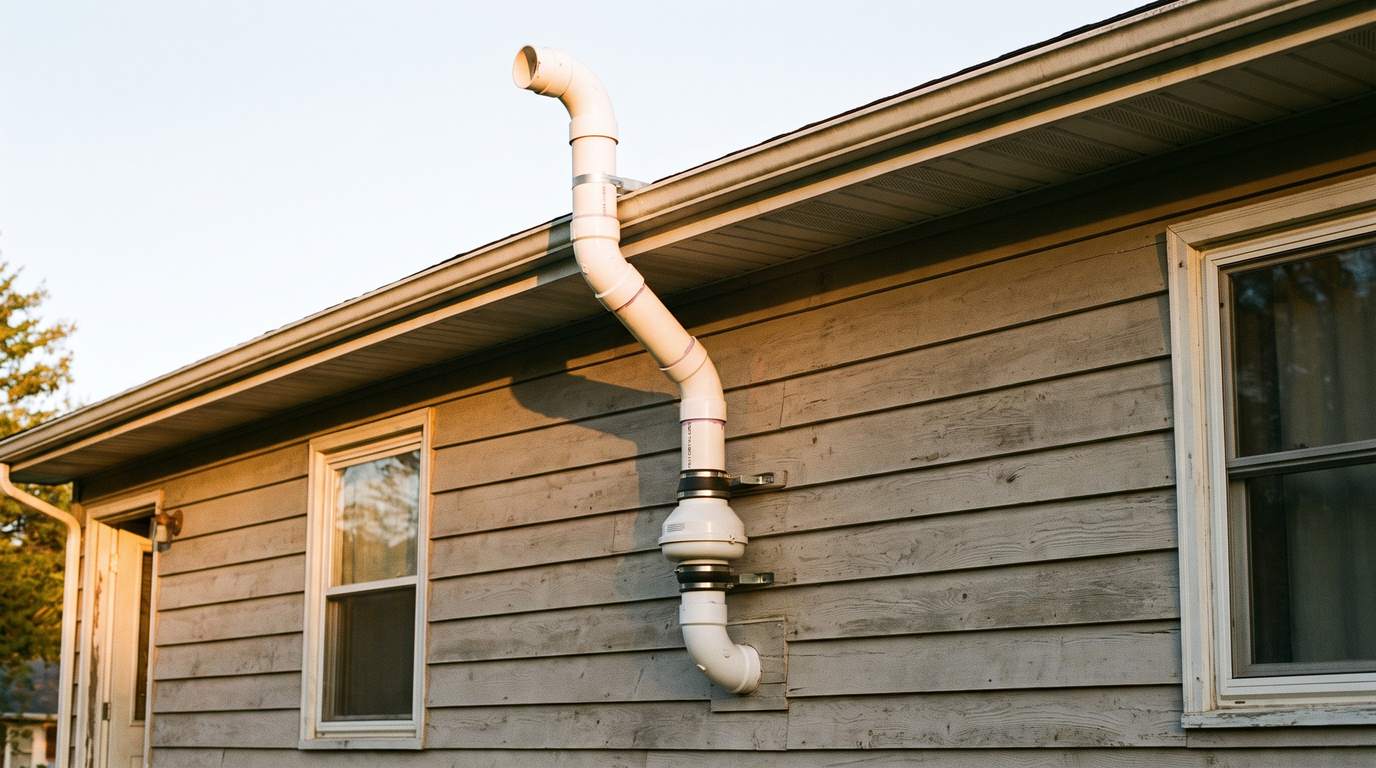
Exterior radon system run on a ranch-style home

How the design changes with the house:

Either way the finish line is identical: an active system built to ANSI/AARST standards, a manometer you can read at a glance, and a post-mitigation verification test proving the number dropped below 4.0 pCi/L.

Radon Service That Fits a Commuter's Week

Most of Black Hawk spends the workday somewhere else, so we've built the process to cost you as little of yours as possible. The quote happens by phone and photos — no sales visit. The install is a single trip, usually three to five hours, and since we work the I-90 corridor between Rapid City and Summerset constantly, scheduling rarely drags.

Costs are predictable, too: a standard single-suction system in this area typically runs about $1,200–$2,500 installed, with a firm written number before any work starts — the cost page shows what pushes a job up or down. And once the fan is spinning, it asks almost nothing of you: about $3 a month to run, quietly, around the clock. If you're buying or selling along the corridor, our real estate page covers how radon fits into a South Dakota closing.

One Call Between You and a Verified Number

Get the test, the fix, and the proof without burning a vacation day. We'll give you straight answers and a firm price today.

(605) 600-8804

Black Hawk Radon FAQ

Does Black Hawk have the same radon problem as Rapid City?

It sits on the same ground. The EPA and USGS map a high-radon-potential ridge around the Black Hills, and Black Hawk's stretch of the I-90 corridor is part of it. Statewide, roughly half of tested South Dakota homes come back above the 4.0 pCi/L action level. Community lines don't change the geology — the only way to know your house is to test it.

Can you mitigate an older Black Hawk home with a sump pit or crawl space?

Yes. Sump pits get sealed, airtight lids so the system pulls from the soil instead of the basement, and crawl spaces get sub-membrane depressurization — a sealed liner over the dirt with suction underneath. Mixed foundations are common in older homes and just mean the system needs to be designed for the house, which is why we diagnose before we quote.

Do I need to take a day off work for the install?

Usually not much of one. A standard residential system installs in a single visit of about three to five hours, and you don't need to leave the house while we work. We schedule around commuter hours where we can, and we confirm the scope and written price before the visit so there are no surprises when you get home.

What does radon mitigation cost in Black Hawk?

A standard single-suction sub-slab system in the Rapid City area typically runs about $1,200 to $2,500 installed. Crawl-space and multi-suction systems run higher, and the South Dakota DANR puts the statewide average around $1,200. We give a firm, written price after we see your foundation — details on the cost page.

Tap to Call — (605) 600-8804